You optimized your calendar.
Your energy still doesn't add up.
No diary. Just data. Bounded Self is a bank statement for your energy. Log what each task costs. See the receipt for your day. Meetings, deep work, context switches, stakeholder management — every task has a price. Now you can see it.
You optimized your calendar. Nobody optimized your energy budget.
You batch tasks, block focus time, and protect your mornings. But by Wednesday afternoon you’re running on fumes. Time management solved the schedule. It didn’t build you an energy ledger.
Not all meetings cost the same.
Not all hours are equal. A 30-minute 1:1 with a difficult stakeholder can drain more than a 2-hour deep work session. But unless you’re logging the cost, it’s untracked spending.
Context switching has a hidden tax
Every Slack ping, every quick question, every tab switch costs 1 or 2. Fifteen of them is a 20. That’s a full category’s weekly budget, spent on interruptions you didn’t approve.
Log in 10 seconds between tasks
After a meeting, before switching contexts, at the end of a work block: rate the energy cost and tag the category. Ten seconds, maybe less. Takes less time than checking Slack.
The math on meetings and context switching
Gloria Mark's research at UC Irvine found that refocusing after an interruption takes roughly 23 minutes.[1] That's measured, not felt. For knowledge workers averaging multiple context switches per hour, the compounding drain is invisible on a calendar but shows up clearly in an energy ledger.
Microsoft's 2022 Work Trend Index found that 68% of workers don't have enough uninterrupted focus time during the workday.[2] The calendar says there's a one-hour gap. The energy data shows that gap cost 6 because three Slack threads and a “quick question” consumed it.
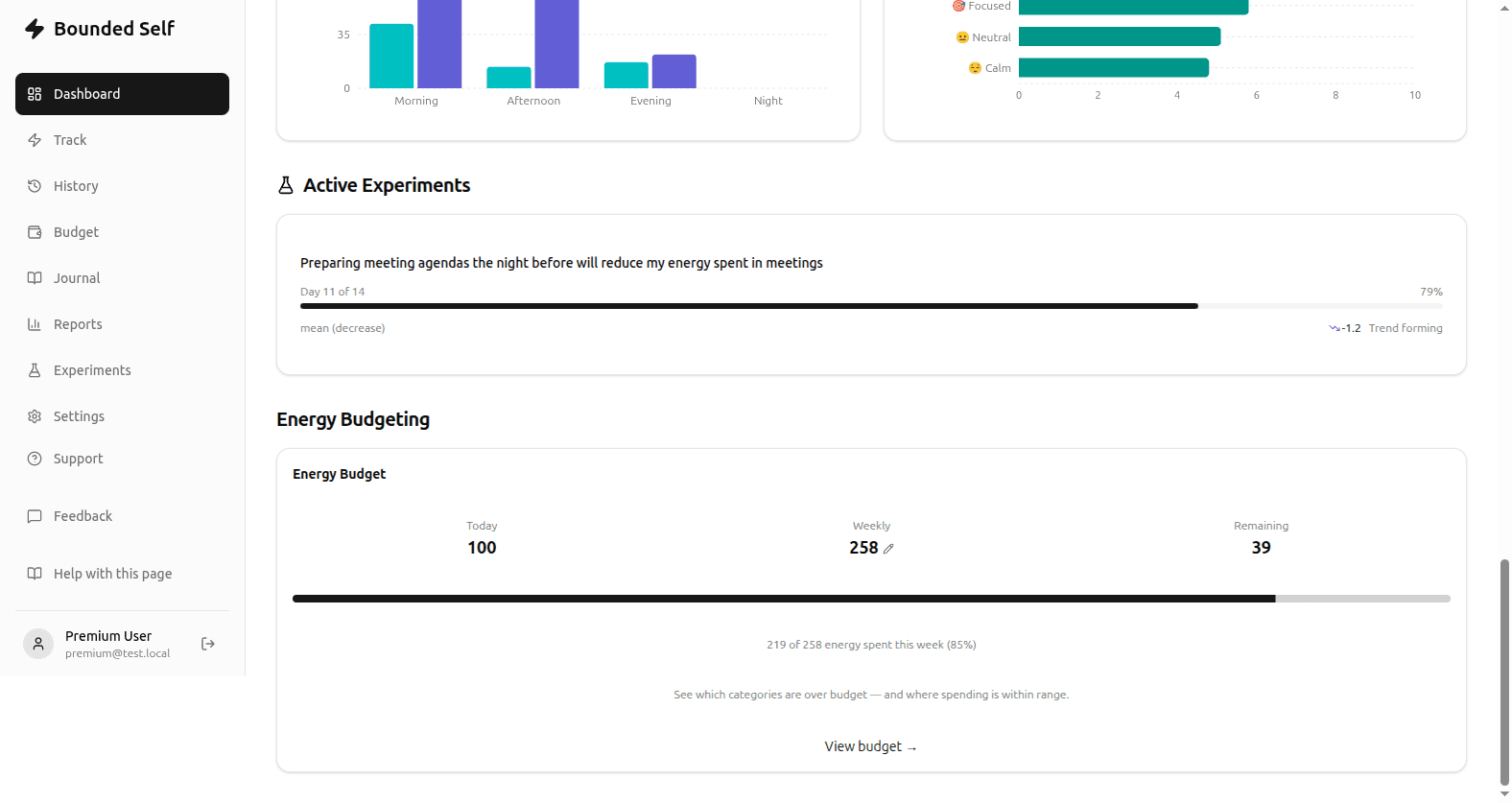
On a 1–10 scale, a meeting that costs 7 happening four times drains 28 units before lunch — that's nearly a full category's weekly budget. Bounded Self shows you whether those context-switching costs are rising week over week — or holding steady.
Spot the cost shifts that matter
Your dashboard surfaces the categories that jumped in cost — including the cost of context switching that never shows up on your calendar. If “Team Meetings” usually costs 3 but hit 7 last week, something changed. Maybe a new team dynamic, a project escalation, a process that broke. That's a clue worth following — and an early indicator of the kind of slow-building pattern that precedes burnout.
Budget your capacity like a resource
Look: energy management for knowledge workers starts with knowing where the costs actually land. Set weekly energy budgets for each category. Protect deep work. Cap meeting costs. When a category overruns, decide whether to absorb it or push back. (Premium feature — tracking is always free.)
Allocate 25 to meetings this week. By Wednesday you've spent 22. The dashboard flags it. You cancel the optional Friday review and protect Thursday for deep work. That's managing capacity instead of reacting to exhaustion.
Sources
- Gloria Mark, Attention Span: A Groundbreaking Way to Restore Balance, Happiness and Productivity, Hanover Square Press, 2023. See also Mark, Gonzalez & Harris, “No Task Left Behind?” Proceedings of CHI 2005. ics.uci.edu/~gmark
- Microsoft, “Work Trend Index,” 2022. microsoft.com/worklab
Common questions
Why am I so tired after back-to-back meetings?▾
Meetings require sustained attention, social performance, and frequent context shifting — each with a cognitive cost. When meetings run consecutively, recovery time between them collapses. The cumulative drain often exceeds the cost of any individual meeting. Tracking the cost of each meeting separately reveals which ones are driving the total.
What is the real cost of context switching?▾
Research from Gloria Mark at UC Irvine found the average worker takes roughly 23 minutes to fully refocus after an interruption. For knowledge workers averaging multiple context switches per hour, the compounding cost is often invisible — it shows up as end-of-day exhaustion, not a specific identifiable cause. Energy tracking makes it visible.
How do you track energy levels as a knowledge worker?▾
Log a 1–10 rating after each major activity — a meeting, a deep work block, a hard conversation. Takes under 10 seconds. Over one to two weeks, patterns emerge: which activities consistently cost more than expected, which are manageable, and where costs have shifted from your baseline.
Is Bounded Self free for knowledge workers?▾
Yes. The free tier includes unlimited energy tracking, entry history with filters, mood tagging, and data export. Dashboard charts cover 7 days; Premium unlocks 30-day, 6-month, and 1-year analysis plus envelope budgeting, custom categories, journal, people and location insights, and detailed reports.
See where your energy actually goes.
No data selling. Ever. Full export. Delete within 30 days.
See your energy receipt — free to startNo credit card required.
Not a mood tracker. A data tool. See pricing.