Your energy has a cost history. Burnout shows up in the data weeks before you feel it.
Log a 10-second entry. See which categories are creeping, and how fast. Bounded Self tracks the shifts: a category jumping from 3 to 6, the same meeting costing double. You can read the pattern before it compounds.
The same meeting costs more than it did last month
Burnout doesn’t arrive overnight. It shows up in the data first: a category that normally costs 3 starts costing 6. Routine tasks feel heavier. You can usually spot these shifts weeks before things get bad.
Trends reveal the trajectory
A single bad day is normal. A consistent upward trend in energy costs across categories is a signal. Bounded Self tracks rolling averages and flags when your baseline is rising.
One data point: pipeline review doubled over 6 weeks
That’s concrete enough for any manager conversation. Instead of “I’m feeling burned out,” you say “this meeting’s energy cost doubled and I need to restructure it.” Numbers make it easier to ask for changes.
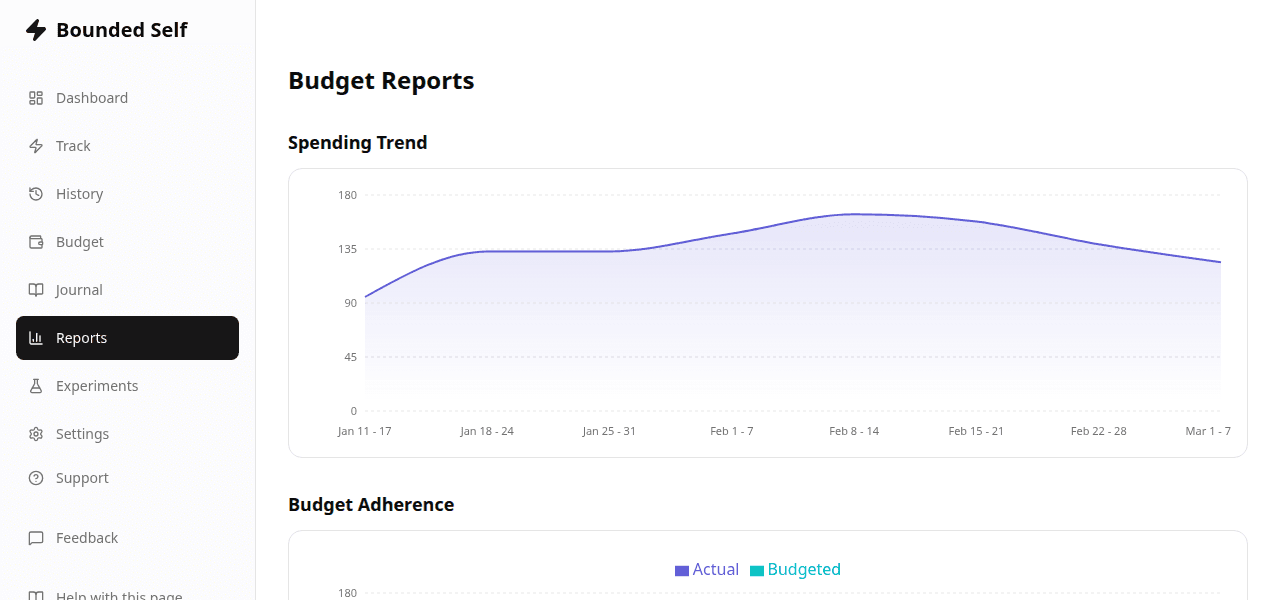
What typically drives the shift
Burnout rarely has a single cause. It's usually three or four things shifting at once, and the combination is what makes it hard to diagnose from the inside. The dashboard shows all of these shifts together so you can see which combination is driving the deficit.
Meetings. Normally cost 3 or 4. When they start costing 6 or 7 consistently, the data trail is clear. Something in the meeting dynamic changed. A new stakeholder, a project escalation, a process that used to be a formality and now requires defense.
Scope creep. A project budgeted at 15 energy points per week starts pulling 25. The overrun shows up in the energy budget before it shows up in the project plan.
Relationship friction. A colleague interaction that used to cost 2 now costs 5. The person didn't change. The dynamic did.
And then there's sleep deficit, which is different from the others. Everything costs more when you're underslept. The entire baseline rises. You see it as a uniform cost increase across all categories, not one category spiking but everything shifting up by 1 or 2 points.
How costs compound
When you consistently spend more energy than you planned, each day of variance makes the next day harder. Bounded Self tracks your daily balance so you can see the pattern forming before it becomes a crisis.
The data exists. Most people just aren't looking at the right numbers.
The WHO classifies burnout as an “occupational phenomenon”[1] — not a medical condition, but a workplace pattern with measurable consequences. Gallup's State of the Global Workplace reports that 23% of employees feel burned out “very often or always.”[2] A 2024 HR industry survey found 69% of workers experienced burnout in 2023.[3] These describe a pattern that shows up as rising energy costs across categories. The people experiencing it usually can't pinpoint what changed until it's already compounded.
When the data makes the conversation concrete
Telling your manager “I'm feeling burned out” lands as a personal complaint with no actionable surface. Telling them “my energy cost for the Thursday pipeline review doubled over six weeks and I need to restructure that meeting” is a data point they can act on. A feeling doesn't give your manager anything to work with. A budget overrun does.
The same applies to conversations with a partner, a therapist, or yourself. When you can point to specific cost shifts (“Social went from 12 to 22 last month, and it's all one relationship”) the insight is concrete enough to act on. Numbers make it easier to ask for changes. For knowledge workers in particular, where the work is invisible and the costs are subjective, having a data trail turns a vague sense of exhaustion into a specific diagnosis.
Act on data, not desperation
The point of tracking isn't to prove you're burned out. It's to catch the trend early enough that you never get there. Cancel the meeting that's costing double. Delegate the project that blew past its energy budget. Catching a meeting that doubled in cost takes one conversation. Catching a six-month pattern takes a restructure. That's the advantage of having a data tool instead of a mood tracker.
Important: Bounded Self is an energy tracking app, not a medical device. If you're in crisis, please contact a qualified professional. Your data export is yours to share with anyone you choose.
Sources
- World Health Organization, “Burn-out an occupational phenomenon: International Classification of Diseases,” May 2019. who.int
- Gallup, “State of the Global Workplace,” 2024. gallup.com
- isolved, “Employees Are Still Burnt Out,” 2024 HR Trends Survey. isolvedhcm.com
Common questions
What is the earliest sign of burnout in data?▾
A cost shift. An activity that used to cost 3 energy units now costs 5 or 6. This shift typically shows up in data 2–4 weeks before burnout becomes subjectively noticeable. Tracking energy by category lets you catch the drift before it compounds.
Why do I feel exhausted after meetings even when they went well?▾
Meetings require sustained attention, social performance, and frequent context shifting, each with a cognitive cost. Research from Gloria Mark at UC Irvine found that refocusing after an interruption takes roughly 23 minutes. When meetings run back-to-back, recovery time collapses and the cumulative drain exceeds any individual meeting’s cost.
How long does tracking actually take?▾
About 10 seconds per entry. Rate the cost, tag the category, done. Most users log 2–3 times per day with 7–10 entries per time, so under five minutes total.
Is burnout a medical condition?▾
The WHO classifies it as an “occupational phenomenon” — not a medical condition, but a workplace pattern with measurable consequences. That framing matters: burnout is a data problem before it becomes a health problem. Tracking the data trail early is the point.
How is this different from a mood tracker?▾
Mood trackers ask how you feel and store the answer. Bounded Self tracks what things cost: a numeric energy score per activity, per category, over time. A mood tracker can tell you Monday was bad. It can’t tell you the Monday pipeline review is what changed.
Start tracking free. Unlock budgets with Premium.
No data selling. Ever. Full export. Delete within 30 days (backups included).
See your energy cost history, freeNo credit card required.