Budget your energy like money.
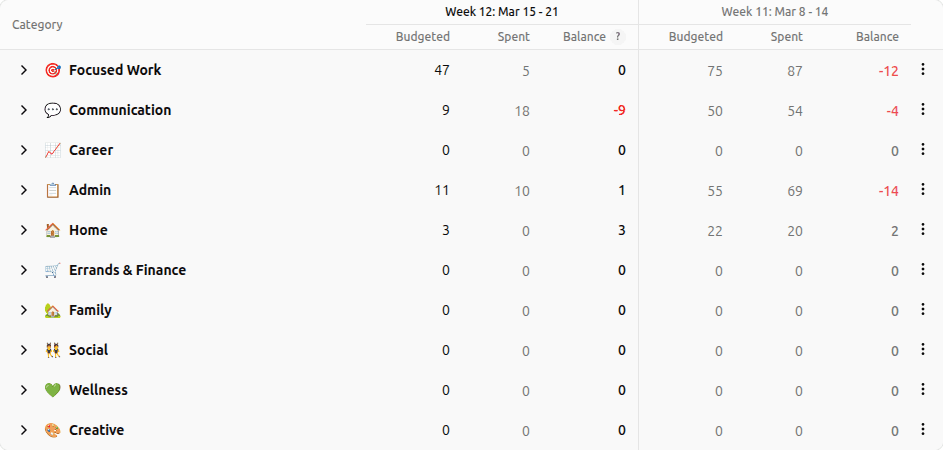
Most people have no idea where their energy actually went until they're overdrawn. Bounded Self gives you a ledger. Set weekly allocations by category, see exactly where you overspent, catch the shift before it becomes a problem. A bank statement for your day.
Tracking is free forever. Energy budgeting envelopes are Premium.
How it works
Set your envelopes
Assign a weekly energy budget to each category — Work, Exercise, Social, Commute, whatever matters to you. This is your allocation: how much energy you intend to spend in each area.
Track actual spending
As you log entries throughout the week, your actual energy costs accumulate against each budget. The dashboard shows where you stand: on track, over budget, or under budget.
Spot the shifts
When a category exceeds its budget, the app highlights it. If Meetings normally costs 15 energy points per week but hit 28, you know something changed — before you feel it.
Adjust and protect
Transfer budget between categories when priorities shift. Carry over unused energy from a light week. Reduce allocations for areas that consistently overdraw.
A week in the ledger
Here's what energy budgeting looks like in practice. Take Marcus, a product manager running five categories:
| Category | Budgeted | Actual | Variance |
|---|---|---|---|
| Work Meetings | 25 | 38 | +13 over |
| Deep Work | 30 | 22 | 8 under |
| Social | 15 | 12 | 3 under |
| Commute | 10 | 18 | +8 over |
| Exercise | 10 | 8 | 2 under |
Meetings ran 52% over budget. That's not a bad week — it's a signal. The Thursday pipeline review alone cost 12. Commute crept up because office days increased from two to four. Neither was obvious without the budget comparison. Both are worth addressing before next week.
Tracking vs. budgeting
Tracking only
- Shows where energy went
- You see patterns after the fact
- No target to compare against
- Useful in retrospect
Tracking + budgeting
- Shows where energy should go
- You see overruns as they happen
- Budget variance is immediately visible
- Useful in-week, before the deficit compounds
Tracking is the bank statement. Budgeting is the spending plan.
Why budgeting beats tracking alone
Tracking shows you where energy went. Budgeting shows you where it should go. The gap between what you planned and what you spent is the interesting part. A category that consistently overruns its budget is either underestimated or out of control. Worth knowing which. If you've used YNAB or envelope budgeting for money, the model is identical — just applied to energy instead of dollars. For knowledge workers, where the costs are invisible and the calendar looks fine, the budget comparison is often the first time they see why Friday feels so different from Monday.
The financial analogy is structural
Energy behaves like a financial resource: you have a finite daily deposit, every activity makes a withdrawal, and consistently spending more than you planned signals something worth investigating. The budgeting tools in Bounded Self — allocations, carryover, transfers, recurring targets — mirror the tools that make financial budgeting work. When the overruns stack up, the data points to burnout signals worth catching early.
Common questions
Is energy budgeting free?▾
Energy tracking is free forever — unlimited entries, entry history with filters, and data export. Dashboard charts cover 7 days; Premium unlocks longer analysis windows plus the budgeting layer (envelopes, allocations, carryover, and transfers). Start tracking today and add budgets when you’re ready.
How much time does it take each day?▾
One entry takes about 10 seconds — rate the energy cost, tag the category, done. Most users log 2–3 times per day with 7–10 entries per time. That’s under five minutes total. The value is in the weekly budget comparison, not in logging volume.
Do I need to track every day for energy budgeting to work?▾
Consistency helps, but perfection isn’t required. Logging 4–5 days per week gives the dashboard enough data to calculate meaningful averages and flag budget overruns. The pattern emerges from the trend, not from any single day’s entry.
Is energy budgeting the same as the YNAB method?▾
Same principle, different resource. YNAB gives every dollar a job. Bounded Self gives every unit of energy a job. You allocate weekly budgets to categories, track actual spending, carry over unused capacity, and transfer between categories when priorities shift. The mechanics are identical — envelopes, allocations, variance reporting.
Give every unit of energy a job.
No data selling. Ever. Full export. Delete within 30 days (backups included).
See where your energy actually went — freeSee pricing — tracking free forever, budgeting is Premium.