Quantified self energy tracking: structured, exportable, yours.
You slept eight hours and hit 3pm exhausted. Your HRV was fine. What changed? You don't have a number for that yet. Bounded Self is a bank statement for your energy. Every cost gets recorded, every shift is visible. And you can export all of it.
No data selling. Ever. Full export. Delete within 30 days (backups included). Revenue comes from premium subscriptions, not your data.
Numeric scales, not emoji grids
Rate energy cost on a 1-10 scale for every entry. The numeric model gives you a dataset you can actually analyze, compare, and trend. Mood icons resist statistical treatment. Numbers don't.
Rolling averages and deviation detection
The dashboard shows rolling 7-day averages per category and flags when a category's cost shifts from your baseline. The flag isn't about high numbers. It's about numbers that moved. Breakdowns by time of day, day of week, and mood.
Full JSON export, always
Download your complete history as structured JSON at any time. Entries, categories, moods, journal notes. Run it through your own tools, load it into a spreadsheet, feed it into R or Python.
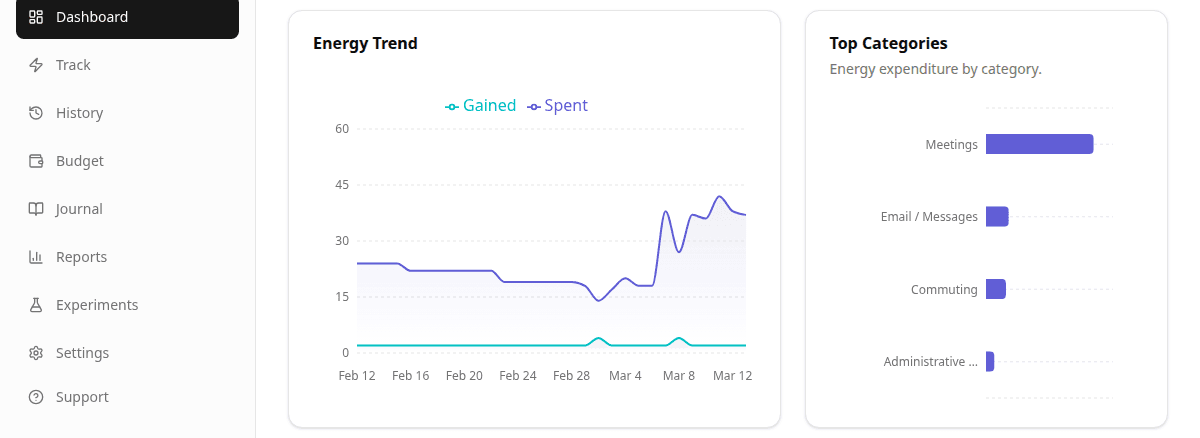
7-day rolling averages with deviation flags, broken down by category.
How the tracking works
Every entry records a single number: how much energy did this activity cost, on a scale of 1 to 10? A low-stakes email might cost 1. A two-hour performance review might cost 8. You tag the category, optionally add mood, location, and people, and move on. The whole thing takes under 10 seconds.
Behind the scenes, the dashboard calculates rolling 7-day averages per category and compares them to your established baseline. When a category's average shifts meaningfully (say, Meetings jumps from 3.2 to 5.8 over two weeks) the dashboard flags it. The math is the same variance analysis used in financial reporting: your baseline is the expected value, and the flag fires on significant deviation. No machine learning, no opaque scoring. Your data, averaged and compared to itself.
What the export looks like
The export isn't a summary or a PDF report. It's your raw dataset. Every entry, every field, structured JSON you can load directly into your analysis environment.
{
  "date": "2026-03-28",
  "energy_score": 6,
  "category": "deep_work",
  "mood": "focused",
  "location": "home_office",
  "people": [],
  "notes": "Two-hour sprint on the API refactor"
}
Load it with json.load() in Python or jsonlite::fromJSON() in R. Pipe it into a spreadsheet. Feed it into your existing QS dashboard. The schema is consistent and documented, no proprietary format to reverse-engineer.
No gamification. Trend lines instead of streaks.
Bounded Self doesn't award badges or push motivational notifications. It gives you a clean dataset, rolling averages, and deviation detection. The same tools used in financial analytics, applied to your energy.
Add the missing column to your personal data stack
You have sleep from your Oura or Apple Watch. HRV from your chest strap. Steps from your phone. Focus time from RescueTime or Toggl. What you don't have is the subjective energy cost layer: the number that tells you whether a day that looked productive on paper actually ran at a cost you can maintain.
Export as JSON and merge it with your existing datasets. Correlate sleep quality with next-day energy costs. Check whether high-HRV mornings actually predict lower afternoon spending. See if your focus-time blocks align with your lowest-cost deep work sessions. This is n=1 experimentation with a variable that no wearable captures: your perceived cost per activity. For knowledge workers especially, it's the column that explains why some optimized weeks still end in exhaustion, and what cost shifts signal before burnout compounds.
Common questions
How does numeric energy tracking differ from mood logging?▾
Mood apps ask how you feel and store an emoji or label. Bounded Self asks what an activity cost on a 1-10 numeric scale (with an option to use emoji-to-numeric mapping). The difference is analytical: numeric data supports rolling averages, variance detection, and cross-category comparison. You can calculate a weekly mean for Meetings, compare it to last month's mean, and detect a statistically meaningful shift. You can't do that with emoji.
Can I use the data export in R or Python?▾
Yes. Structured JSON with consistent field names. Load it with json.load() in Python or jsonlite::fromJSON() in R. No proprietary format.
What does the deviation detection flag mean?▾
When a category's rolling average shifts meaningfully from your established baseline, the dashboard highlights it. The signal is relative to your own history, not a universal threshold. Say your Meetings category normally averages 3.2 and it jumps to 5.8 over two weeks. That gets flagged. But a category that consistently sits at 7 does not, because that's your normal. The flag means something changed, not that something is wrong.
Does Bounded Self sell my data?▾
No. Revenue comes from premium subscriptions. Bounded Self does not sell, share, or monetize your data in any way. You can export everything as JSON at any time and delete your account with full data removal within 30 days (backups included).
What happens to my data if I cancel or Bounded Self shuts down?▾
Your data export is available at any time, before or after cancellation. If you delete your account, all data is removed within 30 days (backups included). If the service ever shuts down, you will receive advance notice and a final export window. Your data is yours to take.
Your data stack has a gap. Fill it.
No data selling. Ever. Full export. Delete within 30 days (backups included).
Start building your energy dataset, free and exportable from day oneTracking is free forever. Energy budgeting (allocations, carryover, transfers) is Premium.