The Affective Marketplace: A Ledger of Human Energy Part 2
- Part 1: The Bio-Economics of Human Energy (The Foundation)
- Part 2: Cognitive Spending & Energy Mismanagement
- Part 3: The Interpersonal Economy: Relational Transactions and Emotional Labor
- Part 4: Emotional Wealth Generation & Systemic Conservation
- Part 5: Analysis of Bounded Self in this intersection
In Part 1 of The Affective Marketplace: A Ledger for Human Energy, we explored some basic concepts around the biological, psychological, and economic spending of mental or psychic energy. This installment focuses on where we deviate from the basic economic theories of spending our resources in an ideal environment and discusses some of the academic ideas around why we spend it in different places. Above are the links to the multi-part article; they will be updated to clickable links as more of this is written.
Part 2: Cognitive Spending & Energy Mismanagement
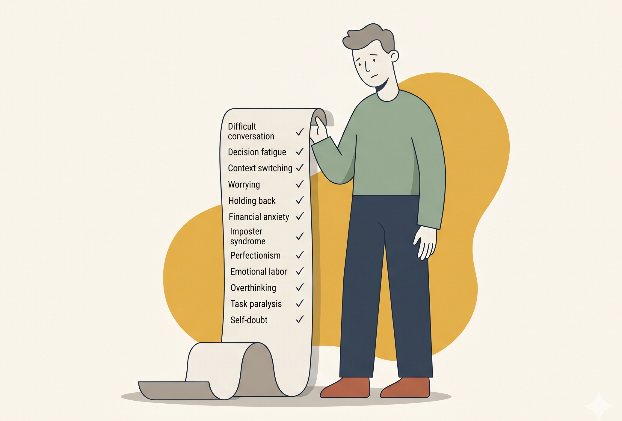
Wouldn't it be nice if we all just lived according to some ideal mechanism for how we spend our resources, and never deviated from it due to inconsistent behaviors or unaccounted-for variables in our lives? Yeah, it might look that way on paper, but our lives would be pretty boring if the assumption of constant states actually held true. We deviate. And the ways we deviate are where behavioral economics earns its keep. The field was originally built to explain why people make irrational choices with money. Why we treat a tax refund differently than a paycheck. Why we stay in losing investments because we've already put so much in. It turns out the same frameworks describe how we spend emotional and cognitive energy. The rest of this piece borrows a few: bounded rationality, mental accounting, the scarcity mindset, the sunk-cost fallacy, and a newer take on what "running out of willpower" really is.
Core Concepts
- Bounded Rationality: the idea that humans try to be logical in their choices, but they frequently do not have all of the information to make choices. They are bounded by the limited information in their rationality.
- Heuristics: these are shortcuts in logic that reach a workable answer quickly, even if they aren't optimal.
- Satisficing: this concept is when we choose something "good enough" that we are satisfied even though it may not be the most optimal.
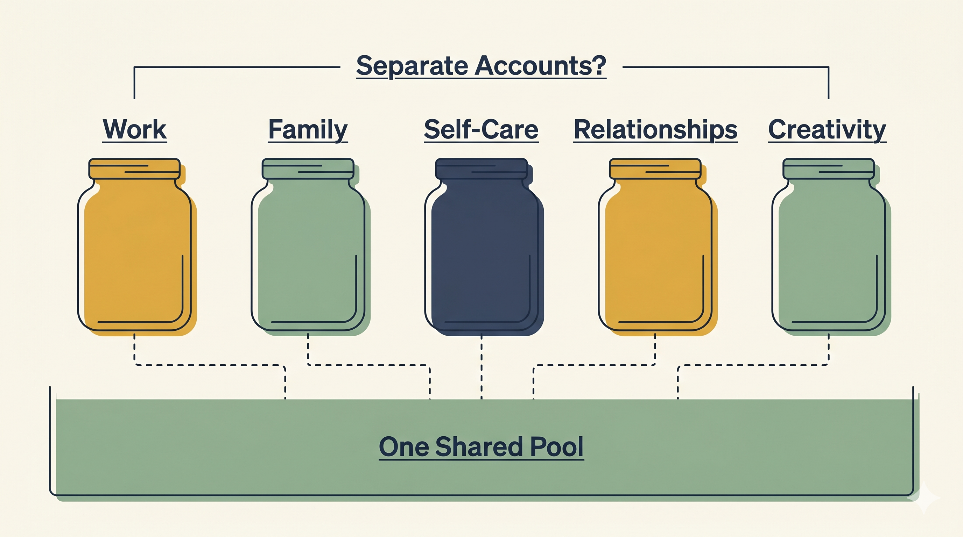
- Mental Accounting: the idea that resources get sorted into separate mental categories that feel non-interchangeable, even when they draw from the same underlying pool.
- Scarcity Mindset: it's what happens when we feel the demands on our resources outpace what we actually have available.
- Present Bias: this is the idea that the present time is more important than the future time; we discount the value of future resources so that current resources become more valuable.
- Sunk Cost: this is the belief that an expense one has paid is material in decisions about expenses in the future.
- Ego Depletion: the idea that our Ego has a single battery from which it pulls energy to complete tasks and that its usage makes future expenditures draw from a depleted pool.
- Opportunity Cost: the value of the next best opportunity to the one that we're currently choosing; it's the cost of what we would have chosen if not for the current path.
Bounded Rationality & The Satisficing Trap
Herbert Simon originated the concept of bounded rationality in describing that humans don't always follow the rational choice due to their limited information. His efforts push economics from the realm of the ideal, rational choice given perfect information into one where we recognize that humans have to take shortcuts to make good enough decisions instead of optimal decisions. Two important definitions come from this:
- Heuristics: There are many different types of heuristics we use on a daily basis to give us these shortcuts. An example, recognition heuristics, are used when we take the shortcut to decision making when the choices include an option we recognize something about (like a brand), then we choose that choice due to its familiarity.
- Satisficing: Finding good enough for you given the limited information that you have. For example, cleaning the house when you have friends coming over may involve just picking up a few items around the house and being satisfied with not having everything in its place or all messes cleaned up; you were satisficing in your decision to only clean that amount.
These two components of bounded rationality solve most things well. The problem, and reason we're exploring it, is that they can also lead to bad decisions and spending our limited resources where we don't actually want them to go. One recognition heuristic (using familiarity instead of information about an actual idea, person, or product) is that I struggle with trusting non-familiar brands when shopping on Amazon. When I see a brand that I recognize (or ones that are made to appear like it), then I usually don't think about the product's safety or longevity, but given the volume of low quality products, I check brand name first before checking reviews. If the brand is familiar and within a few dollars of an unfamiliar one, that makes the selection for me. It becomes a shortcut to the good enough choice for me.
In behavioral economics, the heuristics and satisficing choices we make are generally referred to as fallacies and cognitive biases. We're going to explore a few common ones that you'll see are related to our choices in where we spend our mental energy.
The Illusion of Separate Batteries
The first bias to explore is mental accounting. In Part 1 of this series, we talked about the unified life domain that states that there isn't a separate container for our energy; it all comes from the same place. Mental accounting is the bias to think that some sources are different from each other and have different values. Some instances of mental accounting are when we've already budgeted all of our money, then any excess we didn't budget for isn't as important because it isn't on the ledger. Energy doesn't belong to only work or only the personal life as the resources are spent interchangeably among the two and a deficit in one category has to come from another.
I'm guilty of mental accounting with the biggest fault being calories consumed after exercise feeling like I can have an extra reward for doing the exercise and not counting it towards the overall benefit when trying to watch my waist. The calories I spent riding my bike most definitely don't allow me to then exceed the total amount of calories allotted for the day because both the exercise and the indulgent calories in excess afterwards aren't actually on the budget sheet. These calories belong on the budget sheet, as they are part of the unified domain of expenditures. Our emotional energy, just like those calories, is not part of a separate ledger.
Scarcity Mindset and Present Bias
Resource allocation psychology offers the idea of the scarcity mindset. The mental model of a lack of resources shifts the way that we think about the resources and we approach obligations with constrained thinking. With a scarcity mindset, we begin thinking that we don't have enough to do all the things with the correct amount and start to withhold resources to try to stretch what is available. You can see where this may be problematic; we start taking additional shortcuts and hoarding energy and attention because we don't think we have enough to make ends meet which then lowers the satisficing level of "good enough" to a new level.
What this then introduces is the present bias (also known as hyperbolic time discounting) where we prioritize current demands over future ones. An example of this is where we make the choice to continue doom scrolling instead of sleeping when we're already exhausted. In this example, the present bias places emphasis on spending your energy doing something that gives you the idea of relaxation instead of choosing sleep to recharge yourself. You take the current desire for feeling good over the longer term feeling rested due to present bias.
These two ideas tie into energy spending as yet another resource. When we start to understand that we don't have enough energy to satisfy all of the demands on our time, we often start to approach expenditures of energy from a scarcity mindset. This is the feeling of allostatic load from Part 1 where we begin to see the ASEE increase to consume other parts of the total budget of energy. My experience has been that I don't have time to stop and automate a solution to a problem. I think that because it's faster if I just do it manually right now. I know internally that the long-run scenario will be better if I automate the solution and spend the appropriate amount of energy now, but that's not going to change if I continue to approach it with a scarcity mindset.
The Sunk-Cost Fallacy
Another common mistake people make in their resource allocation is the sunk-cost fallacy. When we have already invested some energy into an idea (given it cathexis, from the previous article), we tend to stick with the idea regardless of it continuing to be the optimal choice. We fail to decathect the energy spent on the idea and continue down the same path when it isn't in our best interest. This idea ties in with the mental accounting bias where, even with the focus on separate accounts, we still make bad decisions based on the history of that mental account.
I used to read books cover to cover. Once I started, if I made it past page 10, then I was going to push myself to make it to the end. The sunk-cost fallacy took place when I would decide that because I started reading the book, I had to finish it in order to say that I tried. If I'm not enjoying it, then why should I finish? The optimal solution, if I'm reading for pleasure, is to just switch to another book if this one just doesn't show any promise.
Ego Depletion and its Criticisms
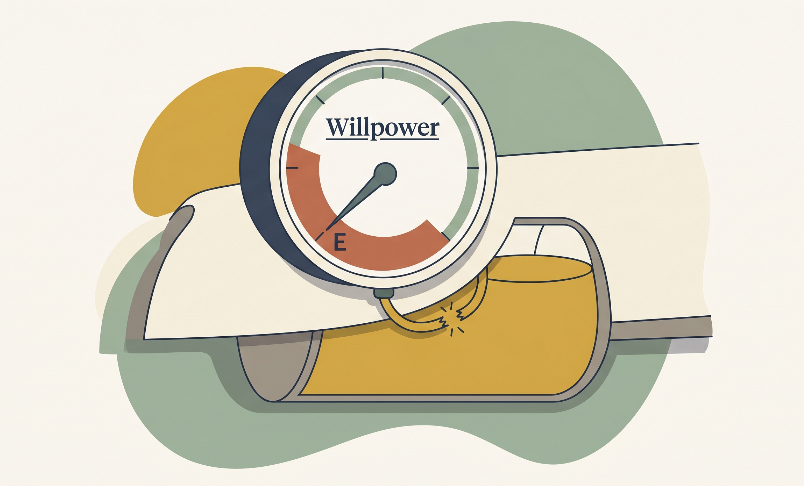
The Ego-based model of psychological energy expenditures originated with Baumeister's Ego Depletion model. The research used four experiments where participants performed one task requiring control and then another task that was designed to consume time. These experiments showed that once a person had already exerted some effort to complete the task, then they were less willing to continue to exert effort in future tasks. This research led the way towards the unified domain model of energy as a single battery. Future research and analysis called this the resource model of control where it asserts that a governing principle of how we spend our energy is based on the energy we have already spent.
The initial research spurred a large volume of future inquiries, but with its criticisms, a lot of the research fell flat. The criticisms disproved the causal relationships suggested, but did spawn two models that continue to show promise.
The Process Model of Ego Depletion
In 2012, Inzlicht and Schmeichel proposed a different model. After the initial self-control exertion in the first task, the mind shifts to reduce the motivation to exert control and expend more energy. It shifts the motivation towards acting on impulse. At the same time, the attention is shifted away from its cues where control is needed and pushed towards looking for a reward mechanism. To give this a relatable analogy, imagine you have been strictly adhering to your diet all week. Each time you make a choice to eat the more healthful choice and stay within your budget. As you do this, your motivation and attention keep shifting more and more towards pleasurable foods leading to Friday night, you binge eat from a bag of chips.
In this analogy, you exerted control the first time and several subsequent times, but your motivation shifts and simultaneously your attention cues start focusing on rewards. After several iterations of control, you reach a breaking point and indulge in the reward. It's not a failure to restrain yourself, but a process where you continually build the shift towards the reward cues.
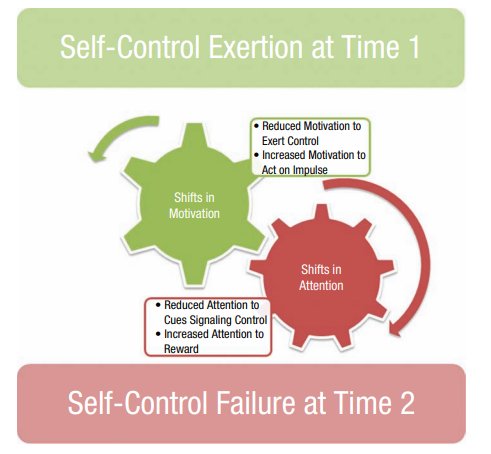 Image taken from Inzlicht and Schmeichel research publication in sources
The Opportunity Cost in Energy
Imagine working late in the office to finish a project before a strict deadline. At first, we weigh the alternative of going home to our family as the opportunity cost. It's something we decide is better if we just catch up on this project. After the first hour, we continue to evaluate the opportunity cost: "should I go home and leave this for tomorrow?" We start to make more mistakes as the energy cost of evaluating the opportunity cost begins to take its toll on our mental labor. This reduced motivation and feeling of reduced energy is the example of the opportunity cost of energy towards completing tasks. Kurzban's research into this model shows that the brain continually computes the opportunity cost when we are exerting energy and this computation is what leads to the increased desire to select the rewarding behavior. It is as though we are continually calculating the cost of the next spoon in spoon theory from Part 1.
Personal Notes
Something I keep coming back to is that most of these biases aren't really about the energy running out. They're about the reading of the energy. Mental accounting miscounts it. Scarcity changes how it feels. Present bias changes which direction you lean when you have to choose. Sunk cost keeps you spending on a specific thing past the point where you should. And the ego depletion stuff, in either of the newer models, is describing a signal the brain sends, not a level in a tank.
Which is worth sitting with for a second, because all of this is happening inside one person's head. Yours.
The Easy Version
Those are the five big ways your own head gets in the way of managing your own energy. Separate accounts that don't really exist. Satisficing when you'd rather be thinking carefully. Scarcity making you cut corners. Present bias making you choose doom scrolling over sleep. Sunk cost keeping you in situations you've already decided aren't worth it. And the feeling of being tapped out, which turns out to be something more like your brain's opinion about what it'd rather be doing than a real reading of what's left in the tank.
Every one of those is something happening inside your own head. That's worth pointing out, because it means we've been talking about the easy version of the problem. You alone, your own brain, your own energy, and the ways you mismanage it when no one else is involved. Which already isn't going great.
Real life isn't that clean. You don't sit in a room by yourself deciding how to spend your energy. You spend it in conversations you didn't pick, on people who need things from you, on work that asks more than it pays, on the constant low-grade effort of managing how you come across to everyone around you. All of that pulls from the same pool we've been talking about this whole time, and all of it has its own rules. This is where Part 3 picks up.
Do you have some thoughts on how this article series is going? Where am I wrong? Where does this fit in with your lived experience? Let's chat in the Bounded Self subreddit!
Sources
Academic Journals, Working Papers & Medical Studies
- Baumeister, R. F., Bratslavsky, E., Muraven, M., & Tice, D. M. (1998). "Ego Depletion: Is the Active Self a Limited Resource?" Journal of Personality and Social Psychology, 74(5), 1252-1265.
- Hagger, M. S. (2013). "The opportunity cost model: Automaticity, individual differences, and self-control resources." Behavioral and Brain Sciences, 36(6), 687-688.
- Inzlicht, M., & Schmeichel, B. J. (2012). "What Is Ego Depletion? Toward a Mechanistic Revision of the Resource Model of Self-Control." Perspectives on Psychological Science, 7(5), 450–463.
- Kurzban, R., Duckworth, A., Kable, J. W., & Myers, J. (2013). "An opportunity cost model of subjective effort and task performance." PMC - NIH.
Books & Encyclopedia Entries
Articles, Blogs & Educational Materials
- Caceres-Santamaria, A. (2026). "How Mental Accounting Shapes Our Financial Choices." Federal Reserve Bank of St. Louis Page One Economics.
- Carrigan, M. (2023). "The concept of cathexis." Mark Carrigan Blog.
- Pilat, D., & Krastev, S. "Bounded Rationality." The Decision Lab.
- PolSci Institute. (2025). "Herbert Simon's Contribution to Decision Making Theory." PolSci Institute.
- Witynski, M. "Behavioral economics, explained." UChicago News.
- iResearchNet. "Resource Allocation Psychology." iResearchNet.
Written by Lawrence Burry | Last Updated: April 30, 2026