The Affective Marketplace: A Ledger of Human Energy Part 1
- Part 1: The Bio-Economics of Human Energy (The Foundation)
- Part 2: Cognitive Spending & Energy Mismanagement
- Part 3: The Interpersonal Economy: Relational Transactions and Emotional Labor
- Part 4: Emotional Wealth Generation & Systemic Conservation
- Part 5: Analysis of Bounded Self in this intersection
Economics is, at its core, the study of how finite resources get allocated under conditions of scarcity. We apply this framework fluently to markets, labor, and capital. We have never seriously applied it to the resource that underlies all human productivity: emotional and cognitive energy. This series is an exploration of what happens when we do.
The Affective Marketplace: A Ledger of Human Energy grew out of my own work on energy tracking and budgeting, and questions that practice surfaces about the deeper economics of how we spend ourselves. There are five parts to this exploration, and I'll update the navigation links above as each is published.
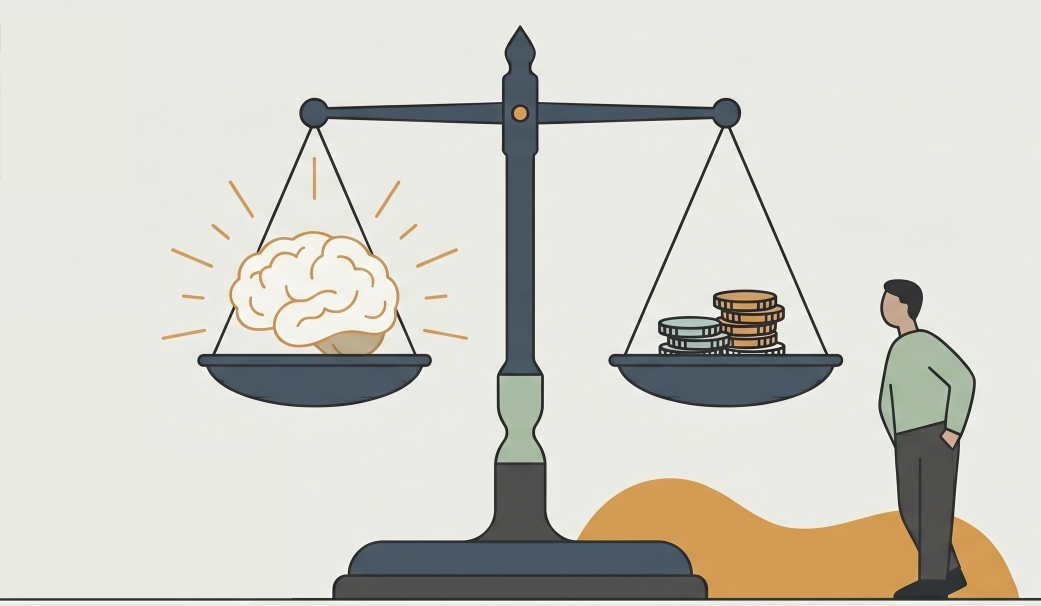
Part 1: The Bio-Economics of Human Energy (The Foundation)
Biology, psychoanalysis, experiential psychology, and economics each have something to say about human energy. It turns out they are saying the same thing. Part 1 draws these four fields into a single framework, exploring how the body keeps an energy budget, how psychology explains the mechanism of spending it, and why the two are more connected than we typically assume.
Core Concepts and Vocabulary
This part explores the foundational ideas of energy across biology, psychoanalysis, experiential psychology, and economics. The concepts below form the shared vocabulary for everything that follows in this series.
- Allostasis: This is the state of a body after changes that came about in response to perceived stress. For example, if you just learned that someone is trying to kill you, then your body will increase adrenaline, body temperature, and other functions in order to help prepare you for defending yourself or preparing to live. This biological mechanism is your body preparing for survival. It extends further, though. If your boss suddenly gives you a new project when you're already feeling overloaded, that's going to elicit a physical stress response as well; you will enter allostasis as a response. It isn't an immediate physical threat, but your body still responds by biological preparation in anticipation of the need to act.
- Allostatic Load and Allostatic Overload: The Allostatic load is a measure of the impact on the body over time from activation of allostasis. That is to say that it is the notion of how often and how long a person is in an allostatic state. This is important because the activation of allostasis is generally caused by chemical or hormonal mechanisms and the repeated and prolonged exposures to these chemicals can lead to negative effects on the body over extended periods of time. For example, if you were often getting a response of an increase in cortisol in response to anticipated stress, then you may start to see the effects of cortisol on your normal, healthy biological functions (memory, muscle growth, etc.). Allostatic overload is a term for when the load becomes excessive and begins to impact normal function.
- Cathexis: This is an English translation of Sigmund Freud's “Besetzung” that conveys the assignment of emotional/mental energy into an “object, person, or idea.” The act of performing Cathexis is ‘to Cathect.’ It is an investment of your mental and emotional energy into something. This concept is commonly used to explain why something is so difficult for us to process (we invested a lot of our energy into it), but the other side of it is that energy has to come from somewhere, and that exists as an economic psychology idea.
- Decathexis: The withdrawal of emotional energy from unfulfilling situations or objects we have lost, and a necessary mechanism for reclaiming emotional capital. Knowing when and how to withdraw emotional energy is as important to the health of the internal economy as knowing where to invest it.
- Unified Life Domain: Dr. Matt Grawitch’s principle that work and personal life draw from a single pool of resources; true separation between the two doesn’t exist. Every demand in your life, professional or personal, draws from the same finite account.
The Bio-Economic Reality of Human Energy
With those terms defined, let’s talk about what energy is and where it comes from. American schools have taught “the mitochondria is the powerhouse of the cell” to the point it’s become memetic and many people don’t understand it, but they know that’s where energy comes from. A simplification is that our digestive system breaks down food into components that are broken down into usable fuel for different cells in our body. These cells then perform actions that consume energy; they move in the case of muscles, they process food for digestion, and they even consume energy through cognition. Our brains take energy to think.
This energy isn’t an infinite source. Sure, we can take in more food and produce more usable energy for the cells in our bodies, but we’re limited by the ability to convert that food and the efficiency of such food in our bodies. So when we make decisions about what actions to take, we’re spending energy that is a relatively limited resource. We make the choice to go for a bicycle ride because the physical exertion allows us to burn off stress hormones from the last allostatic state (or as I say when I often make this choice: “it’s my meditation!”). Expending this limited resource of energy also comes from automatic responses where we become scared or anxious and release adrenaline that makes the heart beat faster, body temperature increase, and move brain activity from the pre-frontal cortex to the amygdala to scan for things that may hurt us and be ready to run from them. These expenditures of energy are constrained economic decisions operating within a system we only partially govern. It is a choice of strategic investment of energy to prevent us from hitting an emotional or energy bankruptcy where we transition to not having spare energy and our bodies have to make decisions about where the energy is going to come from in order to let us keep spending. I liken this to when we start to reach burnout stages, borrowing from tomorrow’s energy to satisfy today’s perceived demands.
The Biological Foundation: The Energetic Model of Allostatic Load (EMAL)
Some fairly recent research from Bobba-Alves et al. in Psychoneuroendocrinology builds the premise for The Energetic Model of Allostatic Load (EMAL). This research builds on a model where the total energy expenditure (TEE) is equal to the basal metabolic rate (BMR) plus the thermic effect of food (TEF) and activity-related energy expenditure (AEE). The team pulls this from existing literature as a basis model and then asserts that there is a level of energy capacity they call the total energy budget above the TEE which is able to be drawn from certain biological functions. One of these is the allostasis and stress-induced energy expenditure (ASEE).
The condensed review of this is as follows:
TEE = BMR + TEF + AEE

Total Energy Budget = X + ASEE + TEE
Where X is other, undefined allowable sources that can tap into the energy reserve.
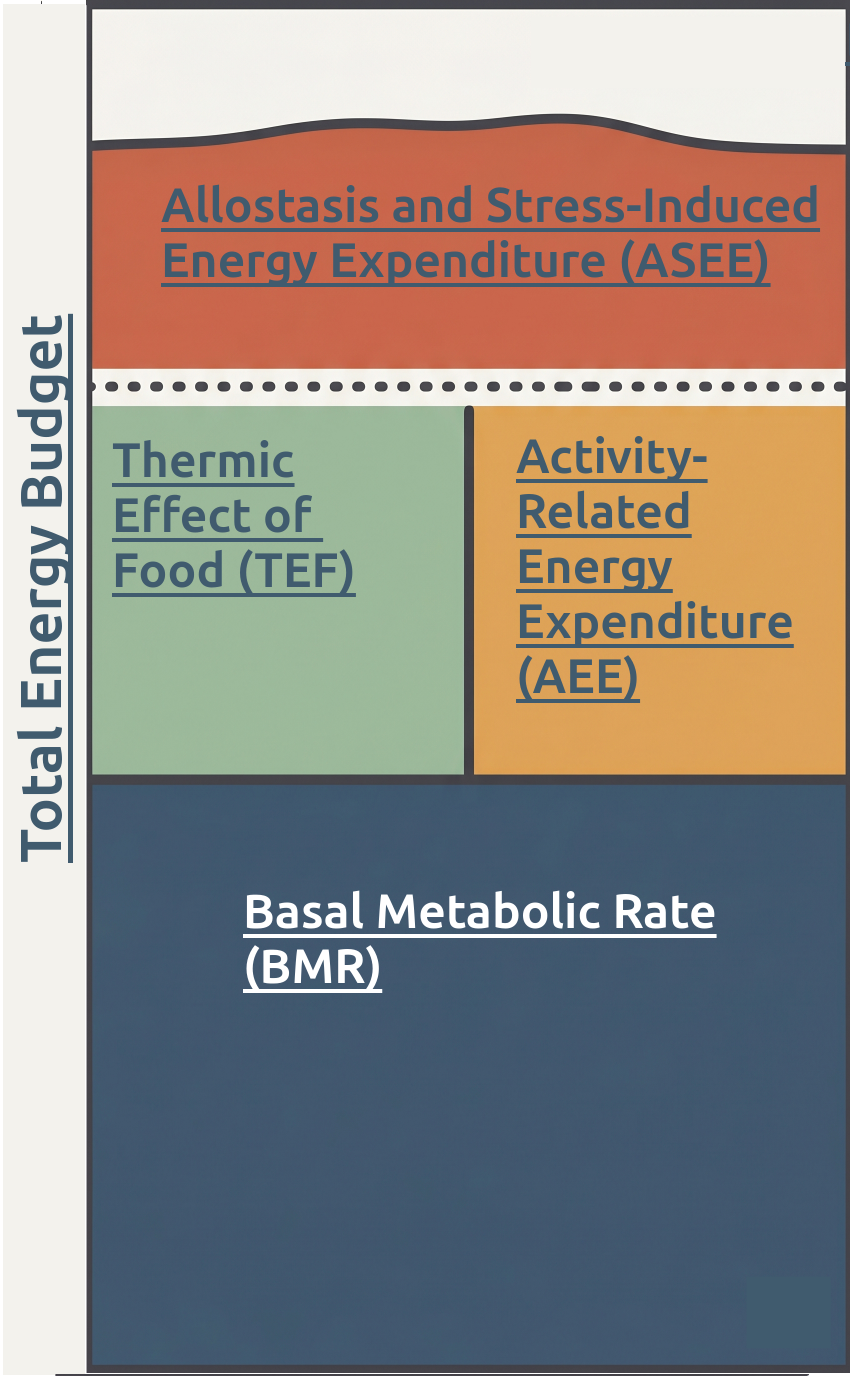
This model of biological and psychological energy is the foundation of EMAL. The authors continue to develop the premise to explain that ASEE can exceed what’s available in the extra capacity and begin to borrow from parts of the TEE. As ASEE is part of the system that prepares us for activities that may be life-threatening, the short-term need to stay alive outweighs those of growth and repair, so it begins to consume the energy reserved for those functions in the BMR. The impacts of this can be devastating over repeated periods of time: “accelerated aging, increased mortality, and shortened lifespan.” This is a fascinating read on the biological energy consumption from stressful situations and the links to burnout and energy budgeting are well worth a full read.
The Experiential Metric: Spoon Theory and Marginal Utility
A popular heuristic used in chronic illness communities is Spoon Theory. Each person has a number of spoons available each day for doing what they have to do. Every task that the person has to do costs a set number of spoons for them that day. Christine Miserandino’s essay that popularized this idea has its participants budget their finite daily allowance each day and evaluate where they start from and then decide what is important within their budget to get done. From doing social media research for Bounded Self, I see a lot of people using this theory as a way to communicate with people who don’t understand why they don’t “try harder” to tell them that they just don’t have enough spoons to do it. Spoon Theory ties into EMAL as a mechanism for managing the amount of energy available so that ASEE doesn’t consume energy outside the Total Energy Budget. If you don’t spend beyond what you have right now, then you are much less likely to overextend yourself and deal with not repairing or healing your body because you spent it while being stressed about other activities. It’s just like managing burnout when we have to tell people “no” so that we stop spending energy on them.
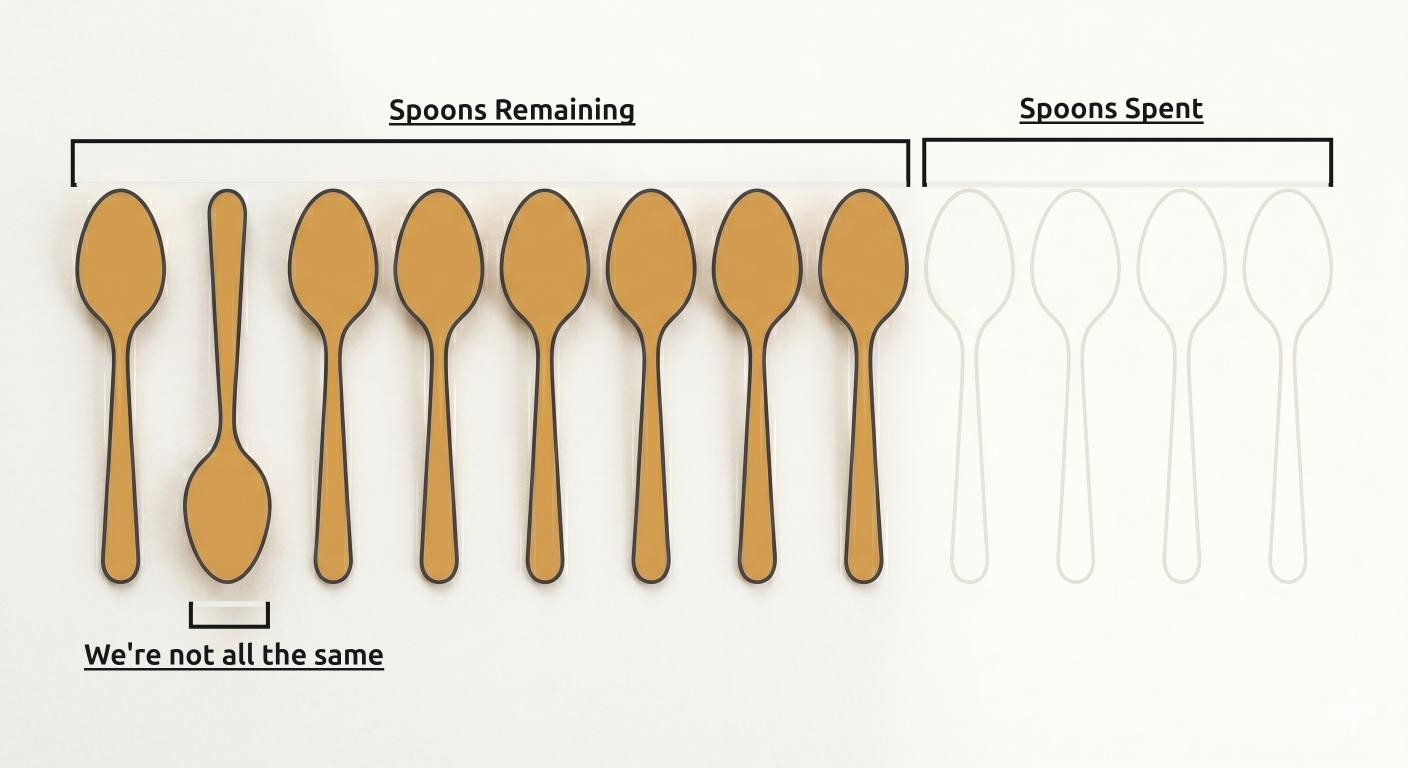
While this sounds very similar to the premise that Elizabeth Patitsas’ essay on Spoon Theory frames it as a resource and a form of capital. The experience of those measuring their energy is such that if they have available energy, they are able to spend it on things that may yield more of that resource (or other resources) that will make life easier. To lend my own example, when dealing with burnout, if I have more energy today to get things done, I can assign that energy to something that will make tomorrow a little easier like taking the time today to add a new email filter that will then reduce the cognitive load tomorrow by improving control around my available energy. The converse is true as well: if I have fewer energy points available to spend, then I’m more likely to just get things done and not pay attention to tomorrow’s load, sometimes taking the cost of energy required today from tomorrow. The fewer points I have left, the less each one buys.
The Psychological Foundation: Cathexis and the Freudian Economy
Taking the concept of spoons as capital into psychoanalysis, we arrive at Freud’s concept of cathexis. We have a finite pool of emotional and mental energy, and we invest it. Whatever receives that investment (a relationship, a career, an idea) becomes important to us by virtue of the energy we’ve placed there. This is why losing something we’ve poured ourselves into hurts as much as it does. It isn’t just the loss of the thing. It’s the sudden return of all that invested energy with nowhere left to go. Cathexis is the mechanism that makes emotional economics personal.
Two classifications of cathexis are defined: self and object. Self-cathexis (also known as narcissistic cathexis) is when we look inward with our energy focus. Things such as learning how to speak in certain ways or paying attention to how we look to ourselves qualify as self-cathexis. Externally, we use object cathexis as a catch-all term for everything external to ourselves. This is when we give our energy to something outside of our realm of control, like our friendships or a job. Freud also defines a concept of Hypercathexis: an intense attachment to the self or an object that can become problematic to the point of obsession. In much of the exploration of this topic, it is consistently noted that there has to be a balance of internal and external energy expenditures as well as regulation around hypercathexis in order to maintain a balanced budget; we need to watch our energy or risk becoming emotionally bankrupt.
In the return flow of the energy capital, we have Decathexis. Decathexis is the withdrawal of energy from unfulfilling situations or objects we have lost. For example, the loss of a romantic partner means that you will reclaim that flow of energy, but it isn’t without difficulty and struggle. Decathexis will become one of the more consequential concepts in this series. As we’ll see in later parts, knowing when and how to withdraw emotional energy is as important to the health of the internal economy as knowing where to invest it.
Practical Application: Personal Resource Allocation (PRA)
Dr. Matt Grawitch wrote a Personal Resource Allocation (PRA) framework for understanding and managing the alignment of emotional energy. His article centers on a concept he calls the “Unified Life Domain”. It is the argument that work stress and personal stress don’t draw from separate accounts. There is only one account, and every demand in your life pulls from it. The cultural shorthand of “work-life balance” quietly implies otherwise, but PRA pushes back on that framing directly.
During the COVID-19 pandemic, working from home, I ran headfirst into this reality. The physical boundary between work and the rest of my life disappeared, and with it any meaningful separation between the two. I was working long stretches without breaks, the demands felt unlimited, and the harder I worked the more seemed to be asked of me. My available time and energy never felt sufficient. That was my first real burnout. At the time I couldn’t articulate why it felt so total and why it wasn’t just work exhaustion or just personal depletion but something that had taken over everything. The unified life domain is the answer to that: there was never a separation to begin with.
In PRA, success and wellbeing for the individual is determined by:
- The demands they face — otherwise being the requests for our resources
- The resources available to them — how much time, energy, and/or money we have available
- Their own perception that they can get by with these resources
Grawitch made some further qualifications before developing a management strategy for how to improve the individual position for these resources and demands. Resources are always limited (scarce in economic terms) and are highly interdependent meaning that time and energy are usually required for all demands, but money allocation can reduce the demand on the former. In the strategy proposed, he advises practitioners to:
- Be attentive to regular frustrations in their lives
- Identify which demands or resources are being spent in those frustrations and how the interaction of those demands with your resources are causing conflict
- Consider what available options there are for modifying the allocation of resources or the presence of demands
- Choose an available option and evaluate whether it makes a difference
The strategy is simple in principle: be mindful of your current state, identify problems with resource allocation, and try to make a change. The challenge, of course, is that executing even a simple four-step framework requires the very cognitive energy you’re trying to conserve. This is the problem Bounded Self is designed to solve by externalizing the unified life domain into trackable data and analytics, the patterns and conflicts in your resource allocation get surfaced for you, so your energy goes toward making decisions, not realizing you need to make them.
Synthesis: The Architecture of Emotional Wealth
Human capacity is governed by biological and economic limits. EMAL demonstrates that our bodies and brains possess a finite total energy budget. When we constantly anticipate threats and manage stress, we incur a massive ASEE and place ourselves under a high allostatic load. If this load becomes overspent, the body is forced to make damaging biological trade-offs, starving vital growth and repair processes. This physiological reality is made operational by Spoon Theory, a heuristic that represents units of physical and mental energy as finite “spoons.” Spoon Theory illustrates the economic law of diminishing marginal utility: as our daily energy reserves dwindle, the physical and psychological cost of spending the next spoon becomes increasingly larger.
We drive these energy costs with the psychological engine of cathexis. Cathecting is the psychological equivalent of spending a spoon to complete a task or connect in a relationship. To manage this internal economy, the PRA framework provides a blueprint. It demonstrates that we operate without separate, isolated energy accounts for work and personal life — in the unified life domain, sustaining emotional wealth means staying honest about what you’re spending and what you actually have to spend it with.
Our cognitive and emotional energy is a liquid asset that must be budgeted to avoid allostatic overload and emotional bankruptcy. We must manage our resources or reach a state of burnout and have to pay back the debt in energy that we have accrued. However, despite the reality of these strict limits, human beings are notoriously inefficient at managing their internal economies. Even when aware that our resources are running low, we frequently overspend our emotional budgets due to deeply ingrained cognitive biases, societal expectations, and psychological defense mechanisms. That systemic mismanagement is what the rest of this series is about.
Part 2 will pick up here, working through the cognitive biases and patterns that cause us to mismanage in the first place.
Sources
Academic Journals, Working Papers & Medical Studies
- Bobba-Alves, N., Juster, R.-P., & Picard, M. (2022). “The Energetic Cost of Allostasis and Allostatic Load.” Psychoneuroendocrinology, 146(805-815):105951.
- Gendron, B. (2004/2005). “Why emotional capital matters in education and in labour? Toward an Optimal exploitation of human capital and knowledge management.” Les Cahiers de la Maison des Sciences Economiques (via ResearchGate).
Books & Encyclopedia Entries
- “Cathexis.” Wikipedia.
- “Spoon theory.” Wikipedia.
Articles, Blogs & Educational Materials
- Aksoy, C. (2017). “EMOTIONAL BANKRUPTCY.” The Journal of Social Science, 1(1), 44-49 (DergiPark).
- Carrigan, M. (2023). “The concept of cathexis.” Mark Carrigan Blog.
- Chicago Psychoanalytic Institute. (2024). “Exploring Cathexis: Understanding Emotional Energy Investment for Personal Growth.”
- Connolly, M. “Feeling Drained? Discover How to Manage Your Energy and Reclaim Your Vitality.” Neways Integrated Wellness Center.
- Grawitch, M. (2021). “A Better Way to Think About Work-Life Balance.” Psychology Today.
- Johnson, P. J. (2012). “Emotional Economics.” USC Dornsife News.
- Kwakyi, G. “How to live sustainably in work and life: balancing 4 types of energy.” The Musing Mind.
- Murphy, T. F. (2022). “Exploring the Concept of Object Cathexis in Psychoanalytic Theory.” Psychology Fanatic.
- OpenStax College. “The Biology of Emotions.” Introduction to Psychology — Lumen Learning.
- Patitsas, E. (2018). “Spoon Theory: A Form Of Capital.” Elizabeth Patitsas Blog.
- Red River Counseling. (2024). “Create an Emotional Budget.”
- Resilience Therapy PLLC. “The Energy Budget: How Mental Health Affects Daily Functioning.”
- Travers, M. (2024). “‘Spoon Theory’ Can Change the Way You View Mental Health.” Psychology Today.
Written by Lawrence Burry | Last Updated: April 30, 2026