The Affective Marketplace: A Ledger of Human Energy Part 3
April 30, 2026
The Affective Marketplace: A Ledger of Human Energy
- Part 1: The Bio-Economics of Human Energy (The Foundation)
- Part 2: Cognitive Spending & Energy Mismanagement
- Part 3: The Interpersonal Economy: Relational Transactions and Emotional Labor
- Part 4: Emotional Wealth Generation & Systemic Conservation
- Part 5: Analysis of Bounded Self in this intersection
In Parts 1 and 2 of The Affective Marketplace: A Ledger of Human Energy, we worked through the closed system. Your energy is finite and it comes from a real biological budget. While our bodies will let us borrow from the future to pay for mental debts we encounter today, it doesn't always let us spend it in the most optimal way. That whole arc was about you alone in a room with your own ledger. Part 3 is what happens the moment somebody else walks in. Above are the links to the multi-part article. They will be updated to clickable links as more of this is written.
Part 3: The Interpersonal Economy
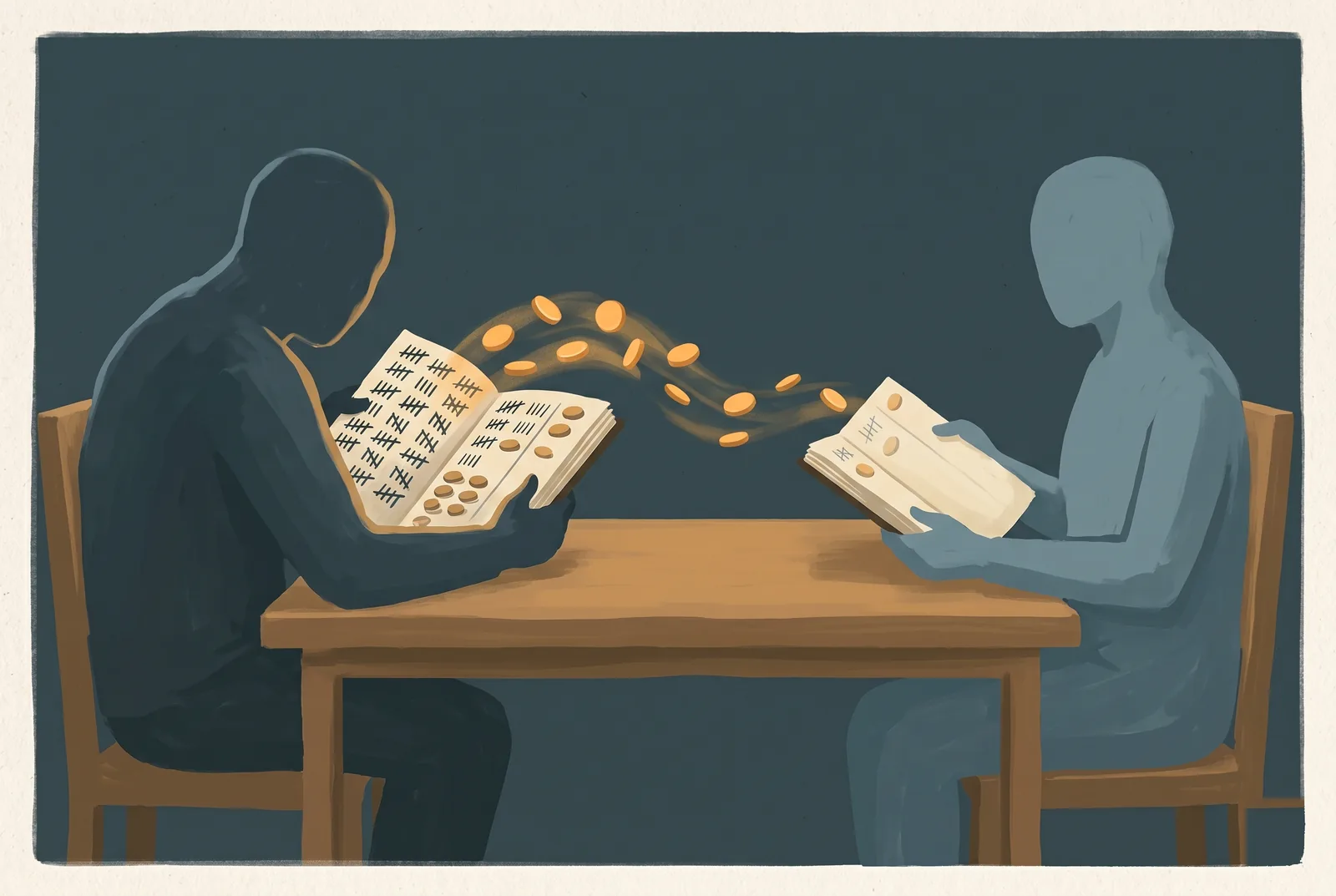
Inside our bodies and minds, we keep a budget where our energy goes, but the minute another person enters the picture, a few things change. There's a counterparty keeping their own ledger, and theirs doesn't have to agree with yours. The returns on what you spend stop being on your timeline. An investment today might pay back next week, next year, or never. Some of what you're spending is going one direction only. It's a performance. You're being paid (or expected) to display a feeling whether or not it matches what you're actually feeling, and the person you're performing for owes you nothing back. The body keeps the receipt either way.
That's the whole essay in three lines. The rest of this piece walks through the academic frame that ties them together (Social Exchange Theory) and two extensions of that theory: an intimate relationship and a paid job.
Core Concepts and Vocabulary
- Social Exchange Theory (SET): The family of frameworks that treat interpersonal behavior as the trade of resources (money, status, information, affection, approval, time). Worth equals rewards minus costs, and both sides keep their own subjective books.
- Reciprocity Norm: Receiving something creates an obligation to give something back. The timeline and amount are both fuzzy and it's enforced socially rather than contractually.
- Emotional Bank Account: John Gottman's metaphor for the running balance of positive and negative interactions between two people in a relationship.
- Bid for Connection: Gottman's unit of relational deposit. A small request for attention, affection, or shared experience. The partner's response (turning toward, away, or against) is the actual transaction.
- Emotional Labor: Managing what you feel, or what you display, in order to meet a requirement set by somebody else (usually an employer).
- Surface Acting / Deep Acting: The two strategies for performing emotional labor. Surface acting changes the display while leaving the felt emotion alone. Deep acting tries to actually change what you feel so the display becomes genuine.
- Emotional Dissonance: The gap between what you feel and what you're displaying.
The Marketplace Goes Social: Social Exchange Theory
Social Exchange Theory was established by George Homans in his essay "Social Behavior as Exchange." He argued that, based on previous experiments, two people in a room are doing economics in their interaction or lack of interaction with each other. Whatever has subjective value to them is on the table. Money, services, status, approval, affection, a piece of information. Every interaction between the two (or more) participants is a trade. He described the categories of exchange as tangible or symbolic, but they could be any mix of those two.
Further research developed the idea from economic exchanges where the value amount and timeframe were specified, but that social exchanges were unspecified. For example, in an economic exchange, I've worked on a contract for a company before where the amount of time was specified, the exact performances were laid out, and the amount they would pay for those services was an hourly wage with no additional compensations. As long as I performed my part of the contract, they were expected (and did) perform their side of the contract so we were able to trust each other through the transactional back and forth. The unspecified terms in a social exchange have more applicability to our lives beyond the job. I help you move this weekend and we both know there's something coming back, but we haven't agreed on what or when. Pretending we did would actually wreck the whole thing. The unspecified part is the entire point. It's why trust and reciprocity matter. They're the substitute for the contract. It's also why the books between two friends, or a couple, or an employee and their boss never actually balance to zero.
On reciprocity, don't mistake unspecified to mean optional. Sociologist Alvin Gouldner wrote about the reciprocity norm as one of the few rules that shows up in every culture humans have ever been studied in. Receiving something creates a real, felt obligation to return something. In cybersecurity, it's one of the key notes to social engineering; if you can give someone something they value, then they are likely to give you something you request back. The fuzzy timeline doesn't make the obligation optional, it actually makes it harder to ensure the two parties agree that the debt is paid.
Cathexis was the Part 1 frame for it. You put a slice of your finite energy into something. A relationship, a project, a career. A chair, even. That works pretty well for chairs, but it leaves something out when the target is a person. People tend to keep their own books on what you've put in, even when they wouldn't say so out loud, and the reciprocity norm seems to mean most of us feel some pull to put something back, whether or not anybody asked. Part 1 framed all this from inside your own head. Social Exchange Theory picks it up from across the table. From over there, the energy you put in starts looking more like a debt the other person is carrying.
You may be saying to yourself, as I have in many relationship arguments, that people don't just keep track of their obligations to each other to maintain a balance sheet. Your experiential evidence is right on point with that. We don't consciously track it and the levels of tracking differ between people. From Cropanzano's literature review on Social Exchange Theory, there were two categories people land on: high and low orientation to exchange. While a high exchange orientation doesn't mean that a person is consciously keeping track, they are more attuned to the obligation that others have with them and less vulnerable to overspending while others accumulate in their interpersonal transactions. Those with low exchange orientation (caregivers, people pleasers, empathic persons) are less likely to track when a person is out of balance with them and are more likely to fall out of balance when reciprocity norms aren't happening. This is where a lot of the unnoticed drift in close relationships actually starts. The high-orientation person can see imbalance accumulating long before the low-orientation person catches on, and by the time the low-orientation person notices, the high-orientation one has often been carrying it alone for a while.
The Emotional Bank Account
John Gottman spent decades watching couples argue in a lab and predicting which ones would still be married six years later. One of his studies followed 130 newlywed couples and predicted divorce versus stability with 83% accuracy. The framework that came out of it has a name most people have heard even if they've never read a Gottman paper, the Emotional Bank Account. Each interpersonal relationship has a shared account.
Like your monetary bank account, there are deposits and withdrawals from the account made by each party to the Emotional Bank Account. The deposit unit is the bid for connection which is a small attempt at attention or affection. Most of them are unremarkable on their own. "Look at that", "How was your day?", "I'm tired." The other person can respond a few ways. Turning toward, where they actually engage even briefly, is a deposit. Turning away, where they miss it, check the phone, or go silent, is a small withdrawal. Turning against, the sarcastic or hostile response, is a bigger one. Gottman's lab has the famous number for this. Couples who stayed married turned toward bids 86% of the time. Couples who divorced averaged 33%.
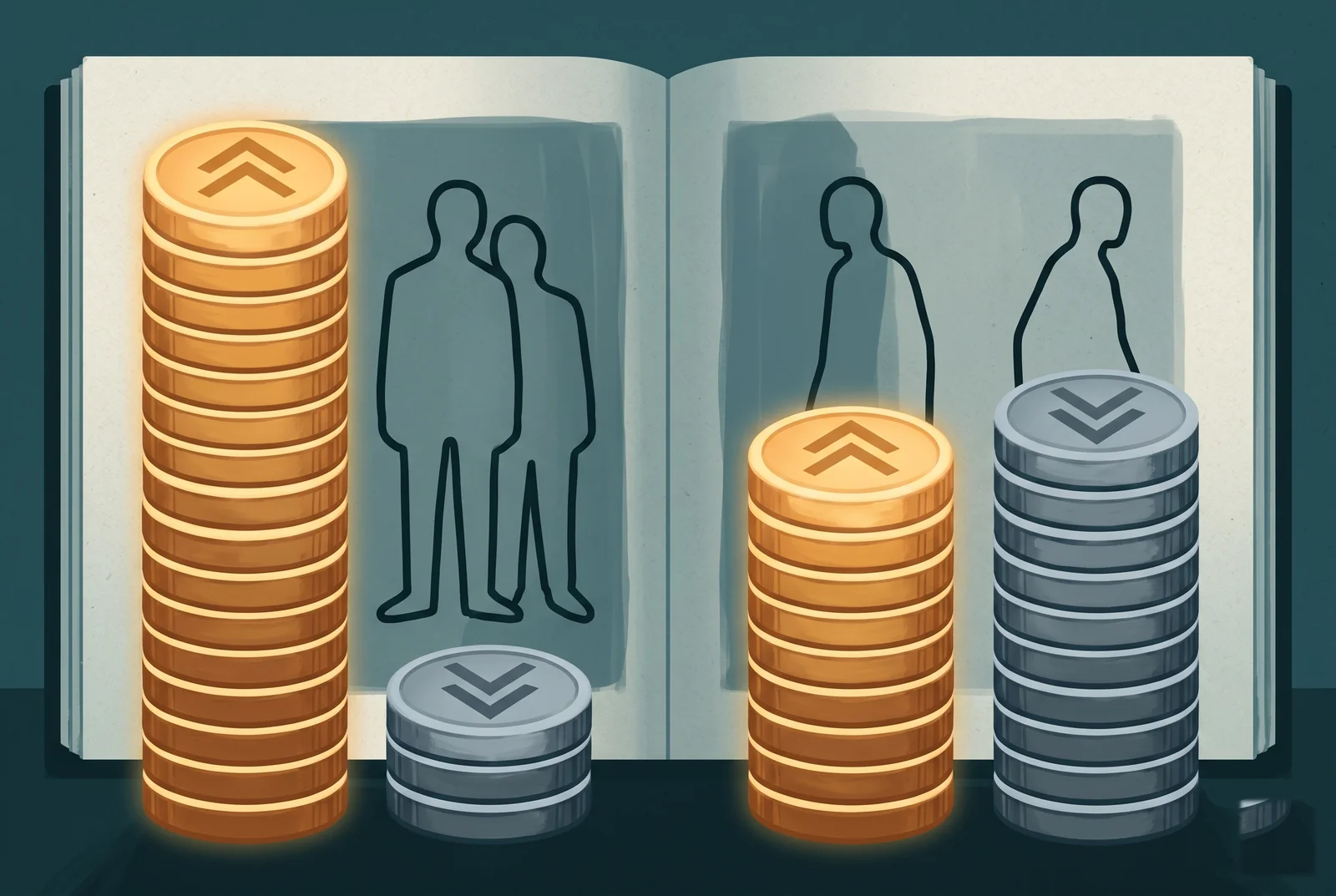
While the language of deposit and withdrawal makes sense for extending the metaphor of a bank account, the ratios are where the value lies in the research. Gottman found that in stable marriages, during a conflict, there was a 5:1 ratio of deposits to withdrawals; couples turned towards each other five times for every one time they turned away from a bid for connection. For relationships that end in divorce, it's closer to 0.8:1. Withdrawals are more impactful than deposits. This last statement is an important concept in human psychology: negative events have more weight than positive events. Thinking back to a recent argument, I recall that my focus was that I was told that I didn't fold the towels correctly. The "thanks for making sure the laundry was done" part wasn't in the forefront because the criticism outweighed it in my mind.
These ratios didn't carry forward in other research for different relationships outside of marriage (work, small-group), but the application from Social Exchange Theory did. Every relationship has bids for connection that are monitored for reciprocation obligations. When a person continues to make deposits more often than withdrawals and maintains a higher account balance, the other members of that relationship are more likely to also contribute positively with the inverse being true about consistent withdrawals.
The Performance Tax from Emotional Labor
Hochschild's The Managed Heart was written as an exploration of the labor that is put on as a performance in trade for a wage. It covers the asymmetric triangle of the worker, employer, and customer. The recipients of the labor (the customer) are not the party paying for it (the employer), so the simple two-party reciprocity norm gets extended to more parties. In the book, emotional labor is defined to describe managing either what you feel or what you display to others as part of the job. Workers performing emotional labor are required to appear a specific way as a part of their job; their employer wants them to portray the image of happiness and whatever their brand requires. While Hochschild and much of the literature focuses on the service industry as the main industry where this is required, I relate it to doing job interviews (although this is emotional labor as predictive of the wage, not in trade of the wage itself). During any interview I've done, it's always important to show up as confident, skilled, and excited to work with that company. It's a performance needed to give yourself a better chance of getting the job.
Emotional labor was later reframed as emotion regulation in Grandey's work and this gives us the two strategies for achieving emotional work: surface acting and deep acting. Surface acting changes only the display that you put on. It's like faking a smile while you're irritated. My sister calls it "her customer service voice" and has won many accolades for it. Deep acting tries to change the feeling itself by reframing the event to be something else, so the display becomes genuine. Both of these have costs that you are exchanging with the asymmetric triangle referenced above. Surface acting is cheap to start and expensive to sustain, because each time you do it you generate emotional dissonance, the gap between what you're feeling and what you're showing. Deep acting is more expensive up front and cheaper to keep doing, because once you've talked yourself into actually feeling some version of the emotion, the display takes care of itself. The latter is also known as method acting in the theatrical community.

This is where Part 1 catches up to us. Surface acting is the relational version of ASEE, the allostasis and stress-induced energy expenditure from the Energetic Model of Allostatic Load. Each instance looks small, but it begins to build up. Some of the findings from the research that match up to this:
- Aung & Tewogbola compiled evidence in their 2019 study connecting emotional labor with poor cardiovascular, metabolic, and sleep outcomes.
- The Korean workplace study by Baek, Yoon & Won in 2023 found emotional regulation demands at work predicting both burnout and sleep disturbance.
- Riley Smith's clinical writeup on the metabolic cost of emotional labor sits on top of the same allostatic-load mechanism Part 1 ended on. The cost shows up in your body, on a delay, dressed up as fatigue or insomnia or a glucose number you can't explain.
The structural point is the one the academic literature has been making since Steinberg & Figart did a review in 1999. Emotional labor markets are typically rigged so the worker pays the dissonance cost while the employer or the customer captures the value. That's why service work, caregiving, and historically feminized labor consistently overspend the budget Part 1 described. The trade in interactions doesn't account sufficiently for the energy needed to overcome the emotional dissonance effect where wages alone aren't a cure for the allostatic load that builds up over time. I felt this strongly when I was in college working a customer service call center for minimum wage. It took just a few weeks for the load of my coursework with the emotional labor of complaints to raise my anxiety levels to something unmanageable. I dreaded going to work or class and knew that something had to change.
It's important to note here that much of the academic literature on this focuses on the job, or work, environment. We're extrapolating the same idea to the surface acting and deep acting that we do for non-monetary value with our non-professional relationships because we weigh the value in those expenditures just as we do with our work lives.
Closing: The Real Cost of Other People

Where this all ties together is that every single interaction with another person has a cost associated with it. Some extroverted people get energy by being around others and actively exchanging ideas and learning about other people. They're making deposits into accounts by actively creating bids for connections with other people. Others dig more deeply into their interpersonal relationships and maintain a more intimate connection. Either way, we're subconsciously watching these interactions and maintaining reciprocity balances for where our energy is spent as a valuable resource to ourselves. Add in that we're masking our feelings in so many of our interactions to project a specific message to other people and our costs are accumulating. Sometimes, we fail to see that we're dumping our resources into a pit that never gives us a solid return on the investment, but we've already put so much in that the sunk-cost fallacy keeps us stuck there instead of beginning the decathecting process for disengaging.
Parts 1 through 3 of this series have been establishing an analysis of literature for how we spend our emotional energy and where it gets spent on what seems like an automatic process. Next, Part 4 is the constructive turn. Emotional capital is the concept it rests on, the resource that converts the skills and relationships you already have into actual performance. It's also what sets the ceiling on how much of any of it you can deploy when you're running low. The question Part 4 takes up is how you build a system, personal and relational and at work, that runs at a positive compounding rate instead of a negative one. The harder version of that question is how you build it so it doesn't collapse the first time you run a deficit.
Do you have thoughts on how this article series is going? Where am I wrong? Where does this fit in with your lived experience? Let's chat in the Bounded Self subreddit!
Sources
Academic Journals, Working Papers & Medical Studies
- Homans, G. C. (1958). "Social Behavior as Exchange." American Journal of Sociology, 63(6), 597–606.
- Gouldner, A. W. (1960). "The Norm of Reciprocity: A Preliminary Statement." American Sociological Review, 25(2), 161–178.
- Cropanzano, R., & Mitchell, M. S. (2005). "Social Exchange Theory: An Interdisciplinary Review." Journal of Management, 31(6), 874–900.
- Gottman, J. M., Coan, J., Carrère, S., & Swanson, C. (1998). "Predicting Marital Happiness and Stability from Newlywed Interactions." Journal of Marriage and the Family, 60(1), 5–22.
- Grandey, A. A. (2000). "Emotion Regulation in the Workplace: A New Way to Conceptualize Emotional Labor." Journal of Occupational Health Psychology, 5(1), 95–110.
- Lu, F., Sun, Y., Hou, F., et al. (2019). "Surface Acting or Deep Acting, Who Need More Effortful? A Study on Emotional Labor Using Functional Near-Infrared Spectroscopy." Frontiers in Human Neuroscience, 13:151.
- Aung, N., & Tewogbola, P. (2019). "The Impact of Emotional Labor on the Health in the Workplace: A Narrative Review of Literature from 2013–2018." AIMS Public Health, 6(3), 268–275.
- Baek, J., Yoon, J.-H., & Won, J.-U. (2023). "Association between High Emotional Demand at Work, Burnout Symptoms, and Sleep Disturbance among Korean Workers: A Cross-Sectional Mediation Analysis." (journal).
- Steinberg, R. J., & Figart, D. M. (1999). "Emotional Labor Since The Managed Heart." Annals of the American Academy of Political and Social Science, 561, 8–26.
Books & Encyclopedia Entries
- Hochschild, A. R. (1983). The Managed Heart: Commercialization of Human Feeling. University of California Press.
- Blau, P. M. (1964). Exchange and Power in Social Life. Wiley.
Articles, Blogs & Educational Materials
- Diamond, M. (2025). "Invest in Your Relationship: The Emotional Bank Account." (publication).
- Gottman Institute. "An Introduction to Emotional Bids and Trust."
- Gottman Institute. "The Four Horsemen: Criticism, Contempt, Defensiveness & Stonewalling."
- Smith, R. "The Metabolic Cost of Emotional Labor: How Absorbing Others' Feelings Drains Your Body." (clinical blog).
- Quality Improvement Center for Workforce Development. "Emotional Labor in Child Welfare Work."
- Pilat, D., & Krastev, S. "Social Exchange Theory." The Decision Lab.
- Tulane University School of Social Work. "What is Social Exchange Theory?"
Written by Lawrence Burry | Last Updated: April 30, 2026